
The short answer
- Chipboard is the cheapest, and the main reason kitchens in Pakistan fall apart. Under the sink it can swell within months.
- MDF is fine for shutters (doors) that get painted or lacquered, but not for the cabinet body near water.
- Plywood is the strongest choice for the kitchen body. Commercial plywood for dry parts, marine (waterproof) plywood under the sink.
- The smart way is to mix: strong board where water reaches, and a cheaper board where it stays dry. That saves money without making the kitchen weak.
Why kitchens are the first thing to break
In most Pakistani homes the kitchen has the hardest life of any furniture. The sink drips. The floor gets a wet pocha every day. Steam from the handi and the pressure cooker goes straight into the wall cabinets. In the monsoon the whole room stays damp for weeks.
Now add the way many kitchens are made: laminated chipboard for everything, with shiny shutters on the front so it looks expensive. In one or two years the sink cabinet floor swells, the bottom edges of the cabinets puff up where the mop touches them, and the hinges start pulling out. The customer paid for a new kitchen and gets a broken one.
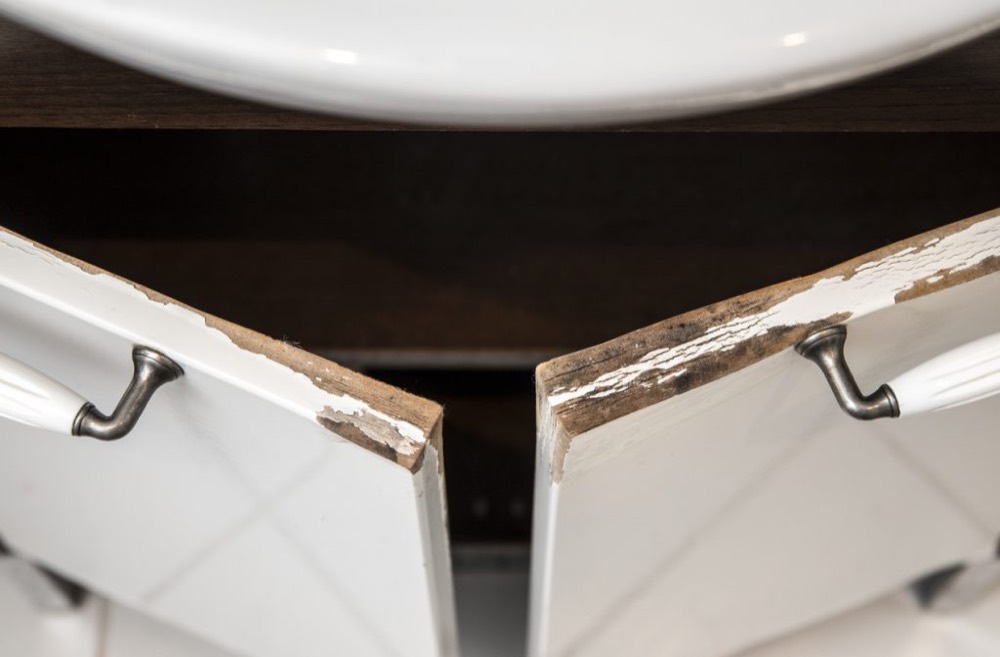
The board you choose matters more in the kitchen than anywhere else in the house. Here is the honest picture so you can decide for your budget.
First, know the parts of a kitchen
A kitchen is not one material. Each part has a different job, and you can choose a different board for each one.
- Carcass (body): the boxes of the cabinets, their sides, bottom and top. This carries all the weight and holds the hinges.
- Shutters: the doors and drawer fronts. This is what you see, so it carries the finish.
- Sink cabinet: the box under the sink. The most dangerous spot in the whole kitchen.
- Shelves and back panel: inside parts. Back panels are often thin 3 to 6 mm sheets.
- Plinth (skirting): the strip at the bottom that touches the floor and the mop water.
Chipboard in the kitchen
Chipboard, also called particle board, is made from wood chips pressed with glue. Most ready-made and cheap kitchens in Pakistan use laminated chipboard, because it is the cheapest thick board and comes with a finished surface.
- Good at: low price, flat sheets, ready lamination so no painting is needed.
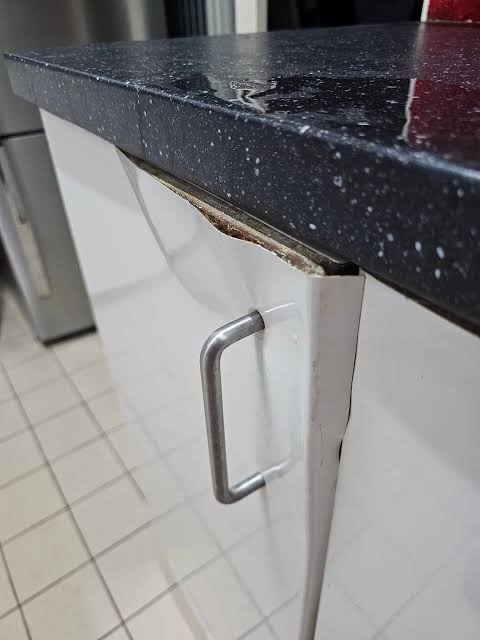
- Weak at: water, badly. Once water gets into a cut edge or a screw hole, it swells and crumbles. Screws and hinges lose their grip after some use.
- Honest verdict: we do not suggest chipboard for any part of a kitchen near water. If the budget is very tight, use it only for upper cabinets on a dry wall, with every edge properly sealed.
MDF in the kitchen
MDF is made from fine wood fibres and glue. It is smooth all the way through, which is why it is the favourite board for painted, lacquered and duco kitchen shutters and for designs cut on CNC. For a deeper comparison of MDF, HDF and HDX, read our MDF vs HDF vs HDX guide.
- Good at: a perfect smooth finish for shutters, no grain or knots, easy to shape.
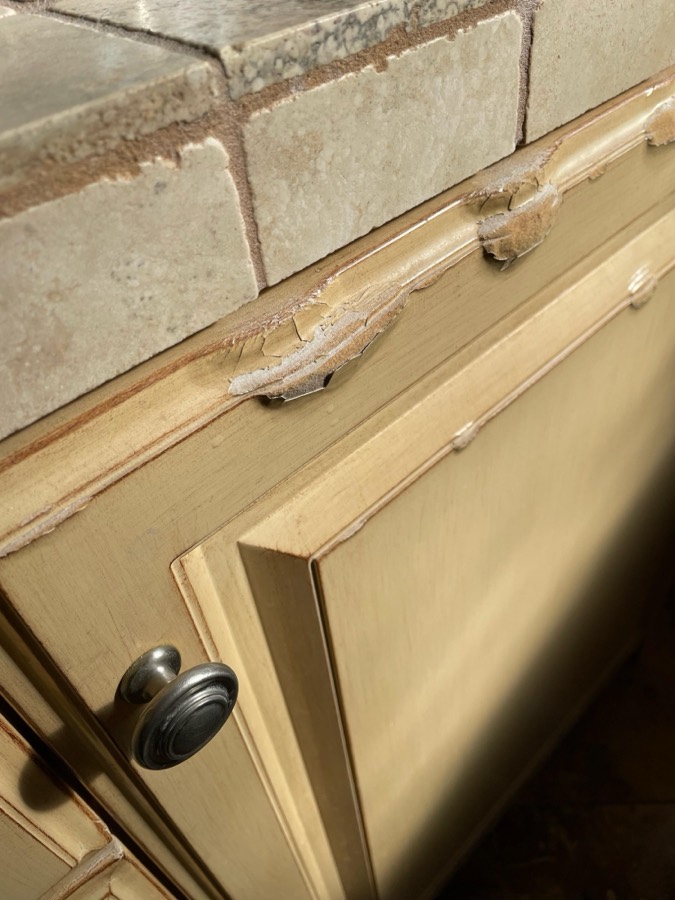
- Weak at: water. It swells like chipboard once water gets in, and the swelling does not go back.
- Honest verdict: good for shutters and upper cabinets. Avoid it for the sink cabinet and the bottom of base cabinets. HDX is the stronger fibreboard option if you want to stay with a fibreboard.
Plywood in the kitchen
Plywood is made from thin layers of real wood glued with the grain crossing each other. This makes it strong, stiff and much better at holding screws and hinges than chipboard or MDF. There are two main kinds you will hear about in the market:
- Commercial plywood: made with normal glue. Strong and handles damp air well, but long contact with water will still damage it. Good for the kitchen body in dry areas.
- Marine or waterproof plywood: made with waterproof glue, so the layers do not open up when they get wet. The best board for the sink cabinet and anything near water. It costs the most.
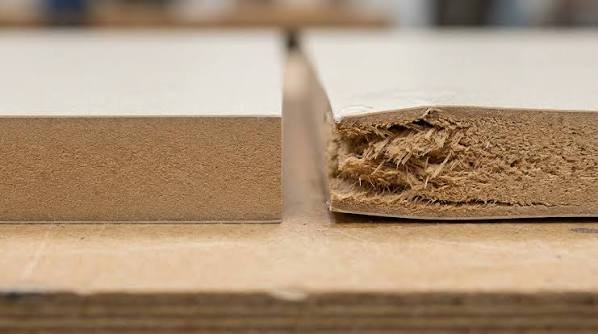
- Watch out: plywood quality changes a lot. Cheap plywood can have gaps inside, weak layers and uneven thickness. Ask for the brand and look at the edge: the layers should be even and tight with no holes.
Chipboard vs MDF vs plywood for kitchens
| Chipboard | MDF | Commercial plywood | Marine plywood | |
|---|---|---|---|---|
| Water and damp | Very poor | Poor | Fair | Very good |
| Hinge and screw holding | Weak | Fair | Very good | Very good |
| Smooth painted finish | No, comes laminated | Excellent | Needs a top layer | Needs a top layer |
| Best kitchen use | Dry upper cabinets only, if at all | Shutters, upper cabinets | Body of base and upper cabinets | Sink cabinet, bottom of base cabinets |
| Real life in a kitchen* | 1 to 3 years. Sink cabinet can go in months | 2 to 4 years. Under a year near the sink | 6 to 10 years | 10+ years |
| Price per sheet | Rs 3,000 to 4,500 (laminated) | Rs 3,000 to 4,500 (plain) | Rs 4,500 to 8,500 | Rs 9,500 to 14,000 |
*Real life in an average Pakistani kitchen, with daily wet mopping, cooking steam and little care, from what we see in the market. Prices are rough November 2026 market rates per 8 x 4 ft sheet of 16 to 18 mm board, and they change almost every week.
How much difference does the board make to the price?
People often think a plywood kitchen costs double. Here is a simple example. Say your kitchen needs about 10 sheets of board. The board cost alone would be roughly:
| All 10 sheets in | Board cost (approx.) |
|---|---|
| Laminated chipboard | Rs 30,000 to 45,000 |
| Plain MDF | Rs 30,000 to 45,000, plus paint or lamination |
| Commercial plywood | Rs 45,000 to 85,000 |
| Marine plywood | Rs 95,000 to 1,40,000 |
Labour, hardware, edge banding, finish and fitting cost about the same whatever board you choose. So moving from chipboard to plywood adds a part of the total price, not double. And if only the sink cabinet and base cabinets are in plywood, the extra is even smaller. Compare that with making a whole new kitchen again in two years.
This is only an example to show the difference. Your real sheet count depends on the size and design of your kitchen.
Our honest suggestion for every budget
| Budget | What we suggest |
|---|---|
| Tight budget | Plywood or HDX for the sink cabinet at least. MDF for the rest of the body and shutters. Every edge sealed with edge banding. Skip chipboard near water completely. |
| Middle budget | Marine plywood for the sink cabinet. Commercial plywood for all base cabinets. HDX or MDF for upper cabinets. MDF shutters with lamination, paint or lacquer. |
| Best quality | Marine plywood for every base cabinet, good plywood for the uppers, and the shutter finish of your choice on MDF or plywood. |
Whatever you choose, we write it in your quote, so you know exactly what you are paying for.
Red flags when someone quotes you for a kitchen
- The quote only says "wood work" or "board". Ask for the board name, thickness and brand for the body, the shutters and the sink cabinet separately.
- Chipboard under the sink. This is the most common shortcut and the first thing to fail.
- No edge banding on hidden edges. Inside and bottom edges must be sealed too, not only the edges you can see.
- A very cheap "plywood" price. If it is much below market, it is either poor plywood or not plywood at all.
- They do not want you to see the work. A good maker is happy to show you your kitchen while it is being made.
How to make your kitchen last longer
- Fix any leak under the sink the same day. A small drip does the most damage.
- Keep a silicone seal where the counter meets the wall and around the sink.
- Mop with a squeezed mop, not a bucket of water. Do not let water stand at the plinth.
- Use the exhaust fan or hood when cooking, so steam does not sit in the upper cabinets.
- Do not keep the gas stove right against a cabinet side. Heat damages lamination and edge banding.
- Wipe the shutters near the stove often. Oil and steam together weaken the finish.
How ARK Woodworks is different
Many furniture shops and even big brands only show you the finished product. They buy from other makers and resell it, so even they do not always know what is inside. We work the other way.
- Honest about materials. We tell you the price, the quality and the expected life of every option, clearly and directly. Then you decide according to your budget.
- Made from scratch, not resold. Every piece is cut, edge banded and built in our own factory on Main G.T. Road, Rawalpindi.
- Precision machines. We use a CNC router, an edge banding machine and a panel saw, so cuts are accurate and edges are sealed properly.
- Any size, any design. Because we make it ourselves, we can customise anything to your space.
- No material change, ever. The material is written in your quote. Once agreed, we do not change it, even if rates go up and we take the loss.
- See it being made. Visit our factory any time to watch your order, and we send you WhatsApp videos at each step.